Opportunities to build a joint Kurdish policy in light of the Middle East crisis
By Kurdyar Dire’i
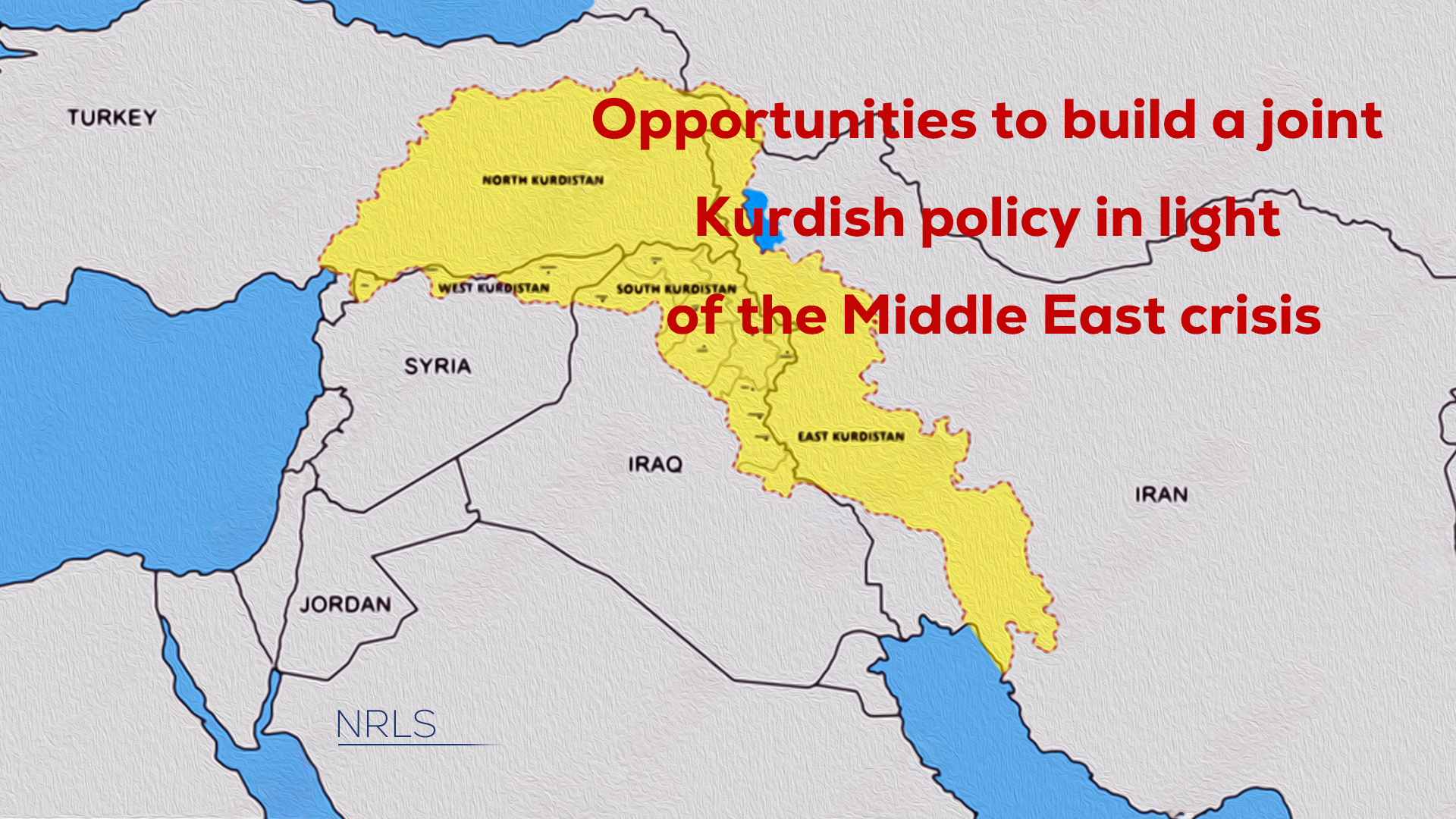
The ongoing war between America and Israel on one side and Iran on the other is not a regional war, nor is it due to disagreements between several parties; rather, it can be seen as the war of the century, a war to redraw the map of the Middle East and divide influence. This war cannot be separated from the global struggle to impose a unipolar system or a multipolar system. The issue of American-Israeli differences with Iran goes beyond the issue of nuclear weapons, supporting terrorism, and Iran’s spreading chaos in the region, to a strategic issue related to the following question: Who draws the map of the distribution of influence in the Middle East? But! In the midst of this ongoing war and the projects behind it that are being implemented; what is the position of the Kurds?
It is no secret that any war that has occurred in the world or in the Middle East has brought with it many major changes, whether political, geographical, or economic, such as World War I (1914-1918), World War II (1936-1945), the Iran-Iraq War (1980-1988), Operation Desert Storm launched by the international coalition against Iraq, the Iraq liberation operation (2003), and the Arab Spring earthquake that broke out in (2010) and is still ongoing and whose effects have not yet ended. Likewise, the ongoing war between America-Israel and Iran will certainly bring with it major changes in terms of geography, influence, and the shape of regimes. One might then ask: Will the Kurdish issue be an active factor in drawing the new map of the Middle East, or will it remain, as it was previously, a tool in the hands of competing countries, and will the need to end conflicts and reach agreements be ignored?
The American and Israeli War with Iran and Strategic Objectives:
The truth is that Israel has significant diplomatic and economic influence on the international scene, including the American scene, and it casts a shadow on the policies of a number of countries. Therefore, with the outbreak of the American and Israeli war with Iran, public opinion, whether in the Arab world, the Middle East, or even to some extent in Europe and America as well, sees this war as a defense of Israel. Israeli economic and diplomatic influence in America does not necessarily mean that the latter is moving according to Israel, but rather there is a sharing of interests and a division of tasks between them. While both are hostile to Iran, they have different and shared goals.
America: Because it sees itself as a great power leading the world order, it sees confronting Chinese and Russian influence as a primary goal. So when it wages war, in addition to preventing Iran from possessing nuclear weapons and breaking its influence, it also aims to break the influence of China and Russia in the region in conjunction with breaking Iran’s influence.
Israel: As a small country in the Middle East, it sees the growing power and influence of Iran as an existential strategic threat to it. Therefore, fragmenting Iran, as well as its arms and influence in the region, constitutes important goals for Israel, so that the latter becomes a major military, economic, and political power in the Middle East.
During the war with Iran, it seems that the difference between American and Israeli goals is that America targets Russian and Chinese influence, while Israel targets Iran itself. Therefore, overthrowing the Iranian regime and dividing the country is not as important to America as forcing Iran to submit to it and accept its projects. However, overthrowing the Iranian regime and dividing the country is within the scope of Israeli goals.
The movement of the Kurds in light of the equation of American and Israeli goals and strategies is not that simple and easy, and it is important for the Kurds to know who is drawing the maps of influence in the Middle East.
Who is drawing maps of influence in the Middle East?
Projects to change the Middle East under the name of the “Greater Middle East” or the “New Middle East” that America named, or projects such as the “Shia Crescent” for Iran, the “New Ottomanism” for Turkey, and “Greater Israel” for Israel; all revolve around the fact that the Middle East, which was formed 100 years ago, should not remain the same, and must change, but each project owner has sought to make this change suitable for his interests.
Besides these parties, there are other influential parties such as Russia, China, Europe, and Saudi Arabia, and there are sub-state forces, such as Hezbollah and armed groups in Syria and some other regions, as well as the Kurdish forces, which are considered among the sub-state forces, are also influencing the shaping of influence in the Middle East.
However, currently, among these forces and parties that are still influential and working actively, we find that America is at the international level, and Israel is at the regional level; especially after the decline of the Russian role due to preoccupation with the war with Ukraine, as well as the fall of the Assad regime in Syria, and the weakness of European influence and impact, except for Britain, which coordinates and cooperates with America, as well as due to China’s preoccupation with the economic issue and its failure to involve itself in the Middle East conflict, neither militarily nor politically.
On the regional level, Iran’s influence, as well as the influence of its arms, has declined after the October 2023 war between Israel and Hamas, and Turkey has been restricted and limited to a large extent; this is due to Israel’s insistence, impetus, and clear confirmation that it will change the features of the Middle East. Among the sub-state forces, the Kurdish forces are now at the forefront, especially after the establishment of the Kurdistan Region, the fight against ISIS, the rise of the Syrian Democratic Forces, the growth of their status, and the influence of the Kurdish movements in eastern and southern Kurdistan.
In short, it can be said that the Kurds have become an influential factor that cannot be ignored in the process of demarcating the Middle East, but not ignoring them is linked to the situation of the Kurds themselves, and from this point it can be said that those who undertake the task of drawing the map of influence in the Middle East are primarily the United States of America, Britain, and Israel, and among the sub-state forces are the Kurds.
The shape of the map of influence being prepared in the Middle East:
There is no doubt that the Middle East is undergoing a process of change, and this change is happening in accordance with the interests of the active and influential powers. We have previously indicated that America, Britain, and Israel are at the forefront of these powers, and that among the sub-state powers are the Kurds. So how do the Kurds move within this equation? What are their calculations? What is their role, what is their impact, and what is their position on the map?
It is certain that the situation of the Kurds in the Middle East is linked to several factors, including: what is the reality of the New Middle East project, whether the Israeli project or the American project? Does the project include geographical division and the formation of new states? Does the project include imposing a model of decentralization on countries, or does it include taming and weakening central states so that the Kurds can also align their projects with these projects, or declare their own projects, so that they work and coordinate together at the level of the four parts of Kurdistan, or that each part works separately in accordance with its own conditions and circumstances? Certainly, answering these questions and possibilities is not that easy.
Since the outbreak of the Arab Spring, some countries in which chaos occurred and internal wars broke out have been subjected to a division of influence on the ground, but no official division projects have occurred, as the priority has become preserving the unity of those countries’ territories and maintaining their official borders; meaning that they remain weak central states, without reaching a sustainable solution or a final form for the conditions of these countries, but rather things have been kept frozen as they are.
Despite the failure to reach solutions to the crises in areas of wars, conflicts, and disputes, the war against Iran has begun, and it is not known what will result from it. Iran has also been exposed to the winds of change, just like the Arab Spring countries, but its fate is still shrouded in ambiguity and uncertainty. Will Iran be divided, or will the regime be changed, or will it be weakened and tamed? These are all scenarios being discussed.
At a time when the war against Iran has not yet subsided, there is talk of the wheel of war moving to Turkey as well, and there is also talk of other countries that will be exposed to changes and crises, such as Turkey, Pakistan, and Saudi Arabia.
Looking at these developments, we see that the Middle East is going through a stage of organized collapse, and it will not remain as it is, but the new form has not yet become clear. However, based on developments, statements, and movements on the ground, we can clarify that changing the Middle East falls within the framework of these goals:
– Imposing Israeli sovereignty over the Middle East politically and economically and obligating Arab and Islamic countries to peace agreements.
– Keeping the main regional countries facing their crises and disputes without finding solutions to them, and managing those crises in their middle stages, meaning postponing solutions until the final form of the new Middle East order is found.
– Breaking the influence of Russia and China, as well as regional countries with expansionist ambitions, such as Turkey and Iran.
By combining the goals of the wars in the Middle East and the goals of the war against Iran, it can be said that the project that achieves all these goals is the spread of the federal system in the countries of the Middle East. However, based on the calm or freezing and keeping the crises of these countries suspended without solutions, and ethnic, religious, and national incitement, we believe that preparations are being made to implement the map of blood, by the American General Ralph Peters, within the framework of the reformulation stage, as the federal system, as well as the borders of blood, achieve the goals of America, Britain, and Israel.
The Kurds, in light of these projects and transformations:
Apart from the framework of any projects for change in the Middle East, the Kurds cannot rely on speculation and statements. The need of international powers for the Kurds as a tool for change for the past 100 years has gone through many experiences. The Kurds have known the results of their reliance on international powers to find solutions for them; since the Treaty of Sèvres in 1920, the Republic of Mahabad in 1946, the revolution of Mullah Mustafa Barzani in 1975, the uprising of southern Kurdistan in 1991, the referendum of southern Kurdistan in 2017, the occupation of Sere Kaniye in Rojava in 2019, and the abandonment of the Autonomous Administration in Rojava in 2026. Most of these experiences have led to the fact that international powers, with changing interests, have changed their dealings with the Kurds and abandoned them, making them victims of their projects. Therefore, in light of the ongoing American-Israeli war against Iran, the Kurds are once again seen as an important tool in confronting Iran, and without providing any guarantees to the Kurds to obtain their rights, resolve their issue, and ensure their protection, they are asked to move. If the Kurds move against Iran, then what are the guarantees that the same experiences we mentioned above will not be repeated if the priorities of America and Israel change? From here, it can be said that whatever the projects of America and Israel regarding Iran and the Middle East, the Kurds must be careful and must have their own decisions and policies, and they must also act according to their interests.
Politics, strategy, and action within the framework of the region’s crisis:
No common goals, strategy, or method for resolving the Kurdish issue have been reached, neither on the level of Kurdistan as a whole nor on the level of each of its parts:
* The movements that take their ideas and philosophy from Mr. Ocalan believe that solving the Kurdish issue in the four parts of Kurdistan lies in confederation, self-administration, and a democratic society. In this way, they go beyond the concept of the nation-state because the nation-state causes injustice, denial, and the outbreak of conflict. Therefore, Mr. Ocalan calls for transcending the nation-state through a multi-ethnic societal democracy, relying more on the policy of benefiting from relations with the societies that make up the state, and not through relations with regimes. As for regimes, Ocalan prefers establishing temporary tactical relations, not strategic ones, and that democracy relies more on its own strength.
* The nationalist movements within the nation-state believe that the solution to the Kurdish issue is general and comprehensive and lies in establishing an independent and united Kurdistan. These movements demand the independence of Kurdistan away from international and regional balances, or the availability of opportunities and possibilities, or the suitability of international policies. This in itself is no more than an emotional policy rather than a realistic one. The example of the independence referendum in southern Kurdistan in 2017 is a good example of this, as the major countries did not support that step, and the regional countries also rejected and confronted it directly. If this indicates anything, it indicates an incorrect reading of international politics, which indicates that the idea of building a Kurdish state is not in the minds of those major countries and is not part of their projects.
* The moderate Kurdish movements believe that the solution to the Kurdish issue in each part of Kurdistan is in accordance with the special situation of that part, and their demands range within the framework of self-administration, cultural rights, language, and local administrations. These movements take into account international and regional balances, as well as their relations with international and regional parties.
Therefore, the absence of a common Kurdish policy, strategy, approach, and goal at the international and regional level weakens the Kurdish issue and also makes the Kurds a tool within the projects of states. When their role ends, they are abandoned. From here, the Kurds must move away from being a “tool” and they must become actors and influencers who have their own project within the Middle East crisis and the regional and international projects related to the Middle East. In this context, Mr. Ocalan talks about the urgent need to hold a national conference that draws up a special Kurdish policy. Mr. Ocalan suggested that Mr. Masoud Barzani lead the conference. During 2025, with the launch of the peace process and the democratic society, Mr. Ocalan sent many messages to the Kurdish leaders, especially regarding the unity of Kurdish policy, and during 2026 he spoke about the issue of the national conference again.
Today, a new opportunity looms for the Kurds in Eastern Kurdistan, and they have become a priority for international powers. The absence of a common Kurdish policy, strategy and goal risks repeating the tragic experiences of the past. Therefore, Kurdish political movements must act quickly. The ongoing war in Iran is a continuation of the wars in the Middle East, but it is a fundamental and pivotal war that will shape the administration of the regional system in general. Thus, the Kurds face two options:
Either the Kurds remain, during these wars, especially in Iran, a pressure card used in the conflict and disputes of the parties, or they transform into an influential and organized actor with a shared vision, policy, goal, and strategy. This means there is a favorable opportunity for the Kurds, and it is known that opportunities do not always repeat themselves. If the Kurdish political movements do not properly understand this historical stage in Iran and the Middle East, and if they do not reach a unified Kurdish position, independent Kurdish decision-making, and the holding of a national conference, then the history of defeat and the use of the Kurds as a tool will repeat itself.
However, if the Kurds succeed in achieving their unity, manage to adopt a realistic policy, build a strategic vision, and unify the goals and methods of resolving the Kurdish issue based on a common democratic project, then, within the framework of the Middle East crisis and the conflict of regional and international projects, and despite all the risks and challenges, the Kurds will be able to present a new, coherent, and confident project for the Kurdish cause.