A Reading of the March 10 Agreement and the Reasons for Failing to Implement It Within the Specified Timeframe
Abbas Sheikhmous
The Syrian people, in all their components and ethnicities, are now awaiting the end of the deadline agreed upon in the March 10 Agreement, with its eight articles, the last of which states that “the executive committees shall work to implement the agreement no later than the end of the current year.” The Syrian Democratic Forces (SDF) and the Autonomous Administration of North and East Syria (AANES), which pursued a distinct course—the Third Way—throughout the Syrian crisis, sought to eliminate terrorism from their regions, foremost among them ISIS and the extremist groups aligned with it. They also aimed to spare the region the destruction that befell various Syrian cities and to extend their democratic model to the rest of the country.
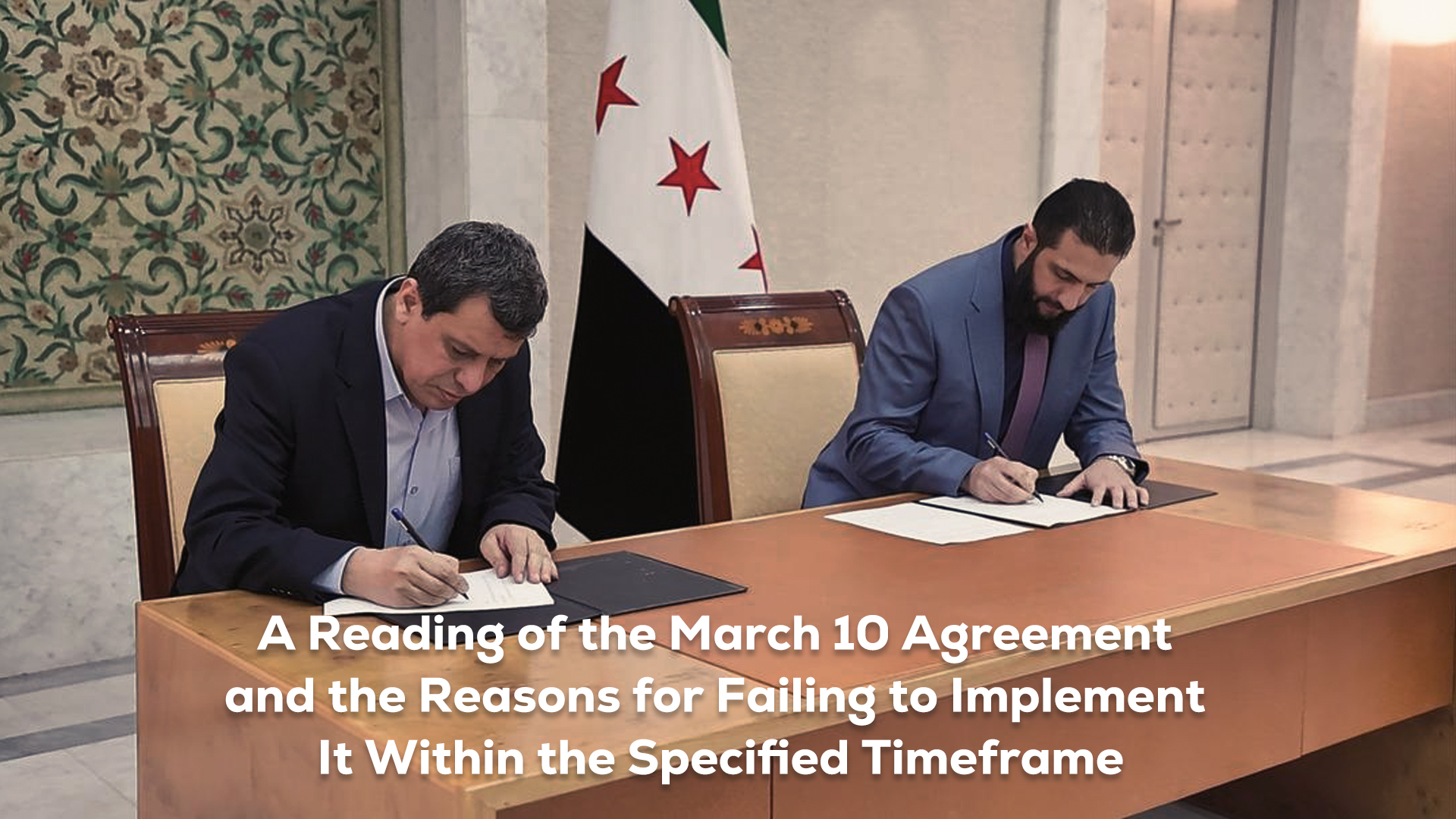
The March 10 Agreement has become a foundation for moving Syria into a phase of reconstruction after more than a decade of devastation, killings, displacement, and conflict between the former Syrian regime and its backers — Russia and Iran — on the one hand, and the various so-called opposition forces (the Transitional Government and the Salvation Government) on the other. This agreement, signed by Mazloum Abdi, SDF Commander in Chief, and Ahmad al-Sharaa, Syria’s Interim President, sought to halt massacres against the people of the coastal region. It stipulated a complete ceasefire across all Syrian territory. However, the new regime did not adhere to this clause. Following the coastal massacres, the regime went on to commit even worse atrocities in southern Syria against the Druze community. Under Israeli pressure, the interim government in Damascus was eventually forced to halt the massacres in Suwayda . Ahmad al-Sharaa (Abu Mohammad al-Jolani) acknowledged that attacking Suwayda had been a mistake—not because of the atrocities committed by factions under his Syrian Army command, but because of the negative consequences: Suwayda slipped out of his control due to Israeli political and military intervention, and because he had misread domestic, regional, and international dynamics. He had believed he could impose his authority over the entirety of Syrian territory by military force and subjugate all communities through massacres, as happened in the coastal region. That area was unlike others, as the Baathist regime had fled and its military units — tied to figures from the al-Assad family and their close associates — had collapsed. The developments in the southern region resulted in political and military consequences that removed Suwayda from the new Syrian regime’s effective control, and signs of an autonomous administration and an emerging military force began appearing in southern Syria.
The threats from the new regime did not stop. After the coastal and southern regions, its focus shifted toward east of the Euphrates—the AANES and the SDF. The regime’s media apparatus — along with its regional backers such as Turkey and some Arab states like Qatar — began working to destabilize the region by inciting the Arab population against the Kurds, portraying the Autonomous Administration as a Kurdish entity. This narrative ignores the fact that the Administration is a democratic system governed collectively by all components of the region. These parties also began promoting the idea that the time for military action was approaching, even though the March 10 Agreement contains no provision allowing the use of force should the executive committees fail to implement it. However, given the nature of the new regime, the ideology it espouses, and its organic connection to the Turkish occupying state — which continues to insist on receiving a green light from the United States to launch a new assault on the region — it is clear that this regime does not wish for the agreement to succeed. Instead, it uses the agreement as a pretext to begin a military operation against the SDF, despite having taken no steps whatsoever toward implementing the accord.
Steps Taken by the New Authority to Implement the March 10 Agreement
The March 10 Agreement includes eight articles intended to serve as a foundation for understandings that would fully resolve the Syrian crisis across all Syrian territory and place the country on the path toward democracy and reconstruction. However, the new authorities claim that the SDF and the AANES have failed to implement the agreement’s provisions. The truth, however, is that the new Syrian government has not adhered to the terms of the agreement. This can be explained through the following points:
- “Ensuring the rights of all Syrians to participate in the political process and all state institutions based on merit, regardless of religious or ethnic background.”
The new authorities have taken no steps toward fulfilling this clause, which is primarily their responsibility. This begins with the constitutional declaration, which is essentially a replica of the Baath-era constitution, and extends to the electoral law for selecting members of the People’s Assembly. The law stipulates that one-third of the members are appointed by the Syrian president (a power granted to the new president), while the remaining two-thirds are chosen through elections but under the strict conditions of the Electoral Commission—meaning anyone opposed to the authorities is barred from running. In addition, the AANES regions and Suwayda were excluded from the electoral process. The new government has continued the one-color political approach of the previous regime, as well as pursuing a policy of “Idlibizing” Syria.
In contrast, the AANES, since its establishment, has ensured that all components participate equally in governing the region without discrimination.
- “Recognizing the Kurdish community as an integral part of the Syrian state and guaranteeing its citizenship and constitutional rights.”
This clause is also tied directly to the new authority’s obligations, specifically recognizing the Kurdish community (the Kurdish nation) as an essential component of Syria. This recognition has not occurred. Instead, the authorities have continued the Baathist policy of politically and culturally ignoring the Kurdish identity in the Syrian constitution. Among the simplest forms of neglect is the refusal to recognize Newroz as a national holiday, insisting instead on marking Mother’s Day on March 21 as an official holiday. Although the Kurdish language has been acknowledged, it has been listed as a “foreign language,” contradicting any genuine recognition of Kurds as an indigenous part of the Syrian state—as though the Kurds arrived in Syria from surrounding regions rather than being historically rooted in their land (Rojava) and within the broader Syrian fabric. Until today, the Syrian government refuses to meet with the committee formed by the Kurdish Conference held in Qamishli to discuss the Kurdish people’s legitimate demands and rights.
- “A complete ceasefire across all Syrian territory.” This clause aims to end the policy of massacres and military operations across the entire Syrian map. However, the new Syrian government has not abided by it and continues to rely on mass atrocities as a means to subjugate Syrian communities. After the coastal massacres, it launched a military operation in southern Syria (Suwayda Governorate), committing atrocities against the Druze community. It also carried out a military campaign in the Sheikh Maqsoud and Ashrafiyeh neighborhoods of Aleppo—areas that fall under the AANES—as well as various scattered military operations along the Euphrates River conducted by factions described as “uncontrolled groups.” Nor did the violations stop there: even the city of Homs has not been spared from the new government’s policy of abuses and killings, with the Alawite community becoming a primary target of the new authorities.
- “Integrating all civilian and military institutions in northeast Syria into the structure of the Syrian state, including border crossings, airports, and oil and gas fields.” This clause falls under the mandate of joint executive committees from both sides. Despite repeated statements by the AANES and SDF commanders expressing openness to Damascus and readiness to implement integration mechanisms—and despite the fact that the AANES’s Social Contract states clearly that natural resources belong to the Syrian people—the Syrian government continues to insist that all civilian and military institutions be handed over fully to Damascus. Their focus remains exclusively on military integration while neglecting the civilian dimension, particularly issues related to Kurdish rights in Rojava and the participation of all Syrian components in running the state. As a result, negotiations have produced no progress. Even SDF Commander Mazloum Abdi’s visit to Damascus to negotiate with Ahmad al-Sharaa—under U.S. sponsorship—did not yield a written agreement; only an oral understanding was reached due to regional considerations tied to the new Syrian government.
- “Ensuring the return of all displaced Syrians to their towns and villages, and guaranteeing their protection by the Syrian state.” Several Syrian regions still host displaced communities due to the crisis and ongoing insecurity. After the fall of the Baathist regime, many displaced people were able to return to their areas—except for the displaced from Afrin, Tel Abyad (Girê Spî), and Ras al-Ain (Serê Kaniyê). This clause is a key demand of the AANES and the SDF to end the suffering of hundreds of thousands from these regions. However, the new Syrian authorities have taken no steps to address this issue. This inaction may be linked to Turkish state policy, which prevents the return of these IDPs in order to complete its demographic-engineering project in the occupied north. Moreover, the armed factions controlling these regions are Turkey-backed militias tied organically to Ankara. Ahmad al-Sharaa has no real authority over them and cannot compel their compliance due to their longstanding military cooperation during the Syrian conflict and because he still needs them to conduct operations in other parts of Syria.
- “Supporting the Syrian state in confronting the remnants of the Assad regime and all threats targeting Syria’s security and unity.” This is a clause agreed upon by both sides. However, the challenge lies in the new authorities’ use of this provision to justify massacres against Syrian civilians under the pretext of pursuing remnants of the former regime. In practice, anyone who opposes the new government’s policies is labeled a ‘remnant of the previous regime’ and punished accordingly—just as occurred during the coastal massacres, which were justified by claiming the victims were loyalists of the old regime.
- “Rejecting calls for partition, hate speech, and attempts to sow division among all components of Syrian society.” No community in Syria seeks the country’s partition—not even the Druze, who firmly reject any calls for secession. However, the policies pursued by the new Syrian government, including the massacres and violations committed against various Syrian components, have pushed these communities to establish self-governance structures. Without these abuses, matters would never have reached this point. The idea of “partition,” promoted by the government, is nothing more than an incitement tactic and a pretext to justify further violations and massacres to impose its authority by force. The volume and intensity of hate speech and incitement propagated by figures affiliated with the government clearly indicate the continuation of the new regime’s systematic approach—one that can be linked to the policies of the Turkish occupying state. It also demonstrates the regime’s lack of commitment to this clause and its unwillingness to achieve genuine peace among Syria’s components. Meanwhile, the AANES’s primary demand remains the establishment of a federal system and the rejection of any form of partition. Yet the new Syrian government claims that federalism or decentralization constitutes a form of division—an argument it uses as a pretext to justify any future military operation against AANES areas.
- “The executive committees shall work to implement the agreement no later than the end of the current year.” Despite the AANES’s attempts to initiate negotiations with Damascus to bridge the divide, the new Syrian government—fully aware that a return to pre-2012 Syria is impossible—has not yet formed executive committees to negotiate with the Administration on implementing the March 10 Agreement. Instead, the government promotes the narrative that if negotiations fail by the end of the set deadline, December 2025, a military option will be on the table to resolve the dispute. This interpretation effectively frames the year’s end as justification for launching a military operation against the SDF. Such a reading aligns closely with Turkish agendas, particularly after Ankara failed to obtain a U.S. green light for a new military offensive against AANES areas.
Failure to Implement the Agreement
The failure to implement the agreement stems from the new government’s insistence on a centralized system—one that has already proven ineffective over past decades—and from its inability, or unwillingness, to properly read the political, military, economic, and international realities shaping Syria today. It is as though the country’s reconstruction depends on restoring centralization rather than achieving national consensus and eliminating terrorism. The new Syrian government’s non-compliance with the March 10 Agreement is tied to both internal and external factors that undermine its implementation. The government either does not recognize, or deliberately ignores, the impossibility of returning Syria to its pre-2012 centralized model or reasserting full political and military control over the entirety of Syrian territory. More than a decade of conflict, regional and international interventions, military fragmentation, and competing ideological visions for Syria’s political future—combined with the exclusionary policies of the new government and its refusal to acknowledge the rights of key Syrian components (Alawites, Druze, and Kurds)—have fundamentally reshaped the country and its governing structure. Following the massacres in Suwayda against the Druze community, it has become impossible for the Druze to accept a regime built on extremism, exclusion, and mass violence. The community now rejects any meaningful authority from the new government over Suwayda and is working toward establishing a form of self-administration and an accompanying military force to protect its rights and security.
Regional interventions—by Turkey, Iran, and Israel—have also significantly influenced the structure of the Syrian state and the direction of its political trajectory. Turkey occupies northern Syria, where its proxy factions answer solely to Ankara and remain entirely outside the control of the new Syrian government. Though Turkey publicly advocates for a centralized Syrian state, its actions demonstrate the opposite: it has no intention of relinquishing its zones of influence and instead seeks to dismantle the AANES and absorb its areas into its sphere of control. Israel, for its part, has increased its military activity in southern Syria since the fall of the Baath regime. It played a political and military role in halting the massacres against the Druze and is working to consolidate its military presence in the areas it has influenced since that time. Alongside the United States and Russia, Israel is also pursuing the establishment of a demilitarized zone in the south. As a result, the south—like the north—is effectively beyond the reach of the new Syrian government. These regional dynamics have collectively pushed Syria, directly or indirectly, toward a decentralized model. The rigid dogmatism of the new government is the primary factor preventing it from implementing the March 10 Agreement.
The United States, despite its openness toward the new authorities and its reception of Ahmad al-Sharaa in Washington, has set clear red lines the government must meet. Hayat Tahrir al-Sham, which constitutes the backbone of the new Syrian military structure, includes armed factions with documented ties to ISIS, in addition to foreign fighters with jihadist ideologies that pose serious security threats to both Syria and the United States. By contrast, the SDF, since their establishment and partnership with the international coalition, have consistently worked to eliminate terrorism in their regions. They cannot integrate into an army that includes factions with long records of abuses against Kurds and Arabs in areas such as Afrin, Tel Abyad, Sere Kaniye, Manbij, and Kurdish-majority neighborhoods of Aleppo. For this reason, the SDF insists on integrating into the Syrian military as a distinct military formation—not as individual fighters—in order to safeguard their regions from terrorism.
What Does the Regime Rely On?
The dogmatism adopted by the new regime, and its refusal to accept others—as though Syria has become its private estate, just as it was previously the Assad family’s domain—does not come from nowhere. Rather, it is grounded in several factors that reinforce its commitment to its current approach to governance in Syria. These include:
- Turkish Support: Hayat Tahrir al-Sham (HTS), which constitutes the core of the “new Syrian regime,” is organically linked to Turkey. This relationship makes it captive to Turkish policy, while in return it receives Turkish support alongside Qatari backing. In the regime’s view, this support grants it an advantage in pursuing its political agenda in Syria and creates obstacles to implementing the March 10 Agreement.
- International Engagement with the New Regime: The new regime interprets international openness toward it as recognition and as a motive to advance its domestic policies—especially after the failure of the fact-finding committee (so to speak, or due to political considerations) to indict it for the massacres committed against Alawite and Druze communities and the absence of accountability. The regime also believes that the suspension of sanctions on Syria is a form of recognition. Instead of using this opening to promote stability and security, the new regime seeks to exploit it to reinforce its dogmatic policies.
- Arab Support: Arab states—particularly Gulf countries, with the exception of Qatar—are working to pull Syria out from under Turkish influence, return it to the Arab fold, and support reconstruction. Given that some Gulf states have reservations about the political model inside Syria (namely federalism), the new Syrian regime exploits this support and these reservations to advance its centralized governance agenda.
- Security Agreement with Israel: The regime, with Turkish backing, believes that signing a security agreement with Israel—and subsequently normalizing relations—could yield several gains including recognition of the new Syrian regime, and political support in regaining areas outside its control, with the exception of the Turkish-occupied north (which is considered Turkish-controlled, and where the new Syrian regime exercises only nominal authority). It believes that winning Israel’s support means winning U.S. support, leading the United States to withdraw militarily from AANES territories and end its partnership with the SDF.
Consequences of the Failure of the March 10 Agreement
Given the Syrian regime’s media machine, which incites against the SDF, stokes sectarian tensions within AANES areas, and fuels anti-Kurdish sentiment inside Syria, the new regime is trying to justify launching a military operation against the SDF. It promotes the narrative that the SDF and AANES reject the implementation of the March 10 Agreement—interpreting the agreement to mean handing over AANES territories to Damascus and dismantling the SDF as a military bloc. The new Syrian regime relies on Turkish support and international engagement to launch a military operation against the SDF early in the new year, after the expiration of the designated deadline, as it believes. Therefore, given the circumstances and the interests of the Turkish occupying power, it is not unlikely that Turkey may push the new regime into a military operation against AANES and the SDF—even if the regime itself is reluctant—since Turkish-backed factions could force the new Syrian regime to become involved.
Syria’s accession to the International Coalition to Counter ISIS—although it will not alter the balance of power by stripping counterterrorism responsibilities from the SDF—may serve as an initial step to prevent a military confrontation between the new Syrian army and the SDF. The SDF’s status as a U.S. ally and a member of the Coalition obliges the new Syrian regime to coordinate with it: two members of the International Coalition cannot be at war with each other inside Syria. Therefore, the SDF must be integrated as a unified military bloc forming the backbone of the new Syrian army’s counter-ISIS efforts and its operations against terrorist factions. Integrating the SDF—as a military bloc—into the Syrian army, which has now joined the Coalition, and enabling it to operate under the Coalition’s umbrella, could yield positive outcomes in eliminating terrorism and establishing security and stability in Syria. Such integration may also produce unfavorable consequences for Turkey’s proxies and could mark the beginning of implementing the March 10 Agreement. However, a core challenge facing the new Syrian regime will be its ability to combat ISIS and its affiliates. During the massacres it committed against Alawite and Druze communities, many of the new Syrian army’s fighters—including foreign militants—openly bore ISIS insignia. In other words, many who joined the new Syrian army espouse ISIS-like ideology. The question, then, is whether the new regime is truly capable of confronting ISIS. How will coordination within the Coalition function under these circumstances? The SDF, supported by the International Coalition—particularly the United States—is the principal force combating ISIS, a reality the new Syrian regime cannot ignore. This necessitates direct coordination with the SDF and recognizing it as the primary component of the Syrian army in counterterrorism operations, pursuing ISIS cells and leaders across Syria, and relying on it to maintain security and stability. If the new regime genuinely intends to combat and eradicate terrorism in Syria, then so-called “tribal forces” and all factions with external loyalties now represent a threat to the current system both internally and externally. Thus, for the new Syrian regime to place Syria on the path toward democracy, reconstruction, and territorial unity, it must rely primarily on the SDF. Moving toward cooperation with the SDF and the Autonomous Administration may pave the way for the full lifting of sanctions and for Syria to regain its regional and international role.
Despite U.S. openness toward the new regime and its reception of Ahmad al-Sharaa at the White House, Washington does not trust the new Syrian system. U.S. reliance remains solely on the SDF in the fight against ISIS in Syria. Now that the new regime has joined the Coalition, it must fully recognize the pivotal role of the SDF and coordinate with it comprehensively in counterterrorism efforts. It must also refrain from being drawn into, or subjected to, regional policies that seek to plunge Syria into further crises and internal conflict—conflicts in which the greatest losers would be the new Syrian regime and the Syrian people. Strengthening national unity is essential for building a democratic, pluralistic Syria.
Syria under the new regime thus faces two limited options either the international engagement, full lifting of sanctions, implementation of the March 10 Agreement, and placing Syria on a democratic, reconstruction-oriented path shaped by all Syrian components—conditions demanded by the United States and Western states, and required by the AANES and the SDF, or the continuation of the Syrian crisis in its new form—massacres, violations, and heightened sectarian tensions—leaving Syria a failed state and a haven for extremist ideology. This is precisely what extremist groups, the Turkish occupying state, and its proxies seek, as an unstable Syria provides them a favorable environment. Ultimately, Syria’s future hinges on the political direction adopted by the new Syrian regime and its willingness to integrate all Syrian components into a democratic, pluralistic system.