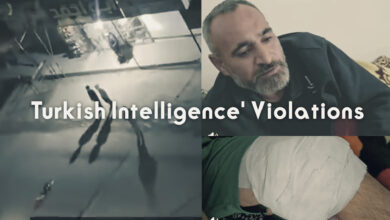
It was committed by the Syrian Arab Army forces and the Public Security forces affiliated with the Syrian Interim Government.
First: General Introduction:
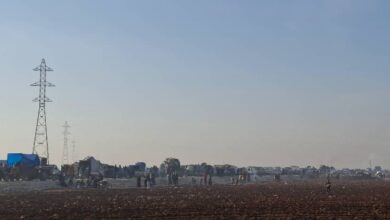
Since January 6, 2026, the Syrian Arab Army forces of the Interim Government, accompanied by elements of the Internal Security Forces, local armed factions, and supporting tribal forces, have launched large-scale military operations targeting areas under the Autonomous Administration in northern and eastern Syria. These operations initially targeted the predominantly Kurdish neighborhoods of Sheikh Maqsoud and Ashrafieh in Aleppo, then expanded to include the towns of Deir Hafer and Maskana on January 17, 2026, eventually reaching Raqqa, Tabqa, Deir ez-Zor, the Hasakah countryside, and the city of Kobani.
These military operations were accompanied by serious and systematic violations of human rights and international humanitarian law, directly targeting civilians, especially members of the Kurdish community, and their effects extended to various communities in the region.
Second: Patterns of violations committed:
Since the attacks began on the Sheikh Maqsoud and Ashrafieh neighborhoods of Aleppo, and continued through Deir Hafer, Maskana, Tabqa, Raqqa, Deir ez-Zor, the Hasakah countryside, and Kobani, northern and eastern Syria have witnessed a wide-ranging and systematic series of human rights violations. These violations have included extrajudicial killings, targeted killings, mutilation of corpses, indiscriminate targeting of civilian objects, including homes and hospitals, as well as campaigns of arrest and torture based on identity, forced displacement, and systematic demographic change.
These attacks displaced over 100,000 people from the Kurdish population in Tabqa and Raqqa, forcing them to flee to safer areas in Hasakah, Qamishli, and Kobani. These displaced people found themselves forced to live in schools, mosques, and camps lacking the most basic necessities, depriving children of education and essential healthcare, and leaving families in a dire humanitarian situation.
The Syrian Arab Army and allied tribal forces also imposed an inhumane siege on the Kobani region and areas in the Hasakah Governorate, repeatedly targeting the existence of the Kurdish people and the dignity of citizens by cutting off electricity, water, flour, medicine and baby formula, which shows that the attacks were not purely military but went beyond that to be a systematic targeting of civilians based on ethnic and political identity.
Among the documented violations in the Sheikh Maqsoud and Ashrafieh neighborhoods were the demolition of walls over the bodies of civilians by armed forces affiliated with the Ministry of Defense of the interim government., the throwing of hand grenades directly into civilian vehicles, the burning and destruction of property, and the use of bulldozers to collect and remove bodies in a degrading manner, in acts of reprisal against the Kurdish population. Cases of injury, abduction, and threats against civilians attempting to flee were also documented, confirming that the violations included simultaneous killing, arbitrary arrest, torture, and forced displacement.
Furthermore, the perpetrators committed grave violations against children and women, including killing, injuring, and abducting children, as well as depriving them of education and healthcare. These acts, committed on a wide scale and systematically, constitute flagrant violations of international human rights law and international humanitarian law, and represent a clear example of a policy of systematic terror against the civilian population in northern and eastern Syria.
Third: Forced displacement and humanitarian conditions:
Military operations and artillery shelling, particularly in the Sheikh Maqsoud and Ashrafieh neighborhoods, led to widespread waves of displacement exceeding 160,000 people, who fled to other neighborhoods in the city of Aleppo and to the Afrin region, in the absence of any guarantees of protection.
The number of displaced people from the Tabqa and Raqqa regions as a result of military operations has exceeded 25,000, most of whom are Kurds. More than 20,000 of them are distributed in the cities of Hasakah and Qamishli, while others headed to the city of Kobani. Most of them come from the Afrin region, which indicates a recurring pattern of forced displacement.
Thousands of families were forced to live in schools, mosques and camps, in inhumane conditions lacking the most basic necessities of life, with children deprived of education and health care.
Fourth: The siege and targeting of civilians in Kobani and areas of Al-Hasakah Governorate:
The Syrian Arab Army and the Public Security Forces of the Syrian Interim Government, supported by armed factions and tribal forces, imposed a suffocating siege on the city of Kobani and large parts of the Hasakah Governorate, in the context of the military operations that have been ongoing since January 2026. This siege included a complete closure of all roads leading to the city, which led to its isolation from its external surroundings and prevented the movement of civilians and basic supplies.
The siege was accompanied by the deliberate cutting off of electricity, water, and communications, as well as the prevention of the entry of flour, basic foodstuffs, medicines, and medical supplies, causing a serious and rapidly deteriorating humanitarian situation. According to the United Nations Office for the Coordination of Humanitarian Affairs (OCHA), humanitarian partners working in the area expressed grave concern about the risk of the humanitarian crisis worsening, particularly given the depletion of food and medicine supplies and the continued operation of health facilities at extremely limited capacity.
The siege also led to successive waves of displacement from surrounding villages to the city of Kobani, in addition to an influx of displaced people from Raqqa, Tabqa, and Ain Issa towards the city, fleeing military operations and the deteriorating security situation. These displaced people found themselves in a besieged city lacking even the most basic necessities for humanitarian assistance, in clear violation of the principles of international humanitarian law, particularly the prohibition of collective punishment and the starvation of civilians as a method of warfare.
Fifth: Extrajudicial killings:
According to unofficial estimates, the bombing and military operations on the Autonomous Administration areas, including the Sheikh Maqsoud and Ashrafieh neighborhoods, resulted in the death of more than 1,200 people, including women and children. Among the most prominent cases:
- A baby died from inhaling tear gas inside the Martyr Khaled Fajr Hospital in Aleppo.
- On January 17, 2026, a displaced family from Afrin was shot in the city of Tabqa by armed elements affiliated with the Interim Government, resulting in the death of the head of the family and the injury of his mother, Maryam (62 years old), and his son’s wife.
- On January 26, 2026, the village of Kharab Ashk, belonging to Kobani, was targeted by a drone, resulting in the death of:
- Fatima Osman
- Jamila Ahmed Osman
- Sulaf Rasho
- Bozan Kadro
- Child Jaafar Mohammed Sheikh Bozan
- Child, daughter of Mohammed Sheikh Bozan
And each of the following was injured:
- Sherehan Haj Mahmoud (32 years old)
- Fatima Haj Mahmoud (17 years old)
- Masoud Sheikh Bozan (5 years old)
- Nasreen Mustafa (25 years old)
- Mohammed Sheikh Bozan
- On January 18, 2026, Kurdish judge Suleiman Ismail was killed while fleeing from Raqqa to Kobani.
- On January 18, 2026, a massacre was committed against a Kurdish family of 12 civilians near the village of Abu Khashab, north of Deir ez-Zor.
- On January 25, 2026, the village of Al-Qasimiya in the Kobani countryside was bombed, resulting in the death of the child Sabreen Ahmed Alawi (8 years old) and the injury of three children.
- Citizen Sadiq Muhammad Yassin (47 years old) was killed while trying to rescue his family on the Raqqa-Kobani road.
- The child, Muhammad Msi Kolk (15 years old), was martyred along with his father on the Raqqa-Kobani road.
- On February 13, 2026, Mrs. Huda Muhammad Khair and three of her children were killed after a civilian car was targeted in the Hasakah countryside.
- A Kurdish family of 5 people from the village of “Kork” in the northeastern countryside of Kobani were killed while trying to leave the city of Raqqa.
- On Monday, January 19, 2026, elements of the Syrian Arab Army committed a murder against citizen “Hanan Muhammad Qisho” in the city of Tabqa, from the people of the village of “Khalil” in the Shieh/Sheikh al-Hadid district in the countryside of Afrin, on the public road while returning from the city of Tabqa to the Afrin region.
Sixth: Arbitrary arrest and enforced disappearance:
Human rights organizations documented a widespread wave of arbitrary arrests and enforced disappearances targeting civilians in areas of northern and eastern Syria, particularly in the Sheikh Maqsoud and Ashrafieh neighborhoods of Aleppo, following the takeover of the two neighborhoods by the Syrian Arab Army and Public Security forces in January 2026. More than 2,000 people, including women and children, were abducted and arrested and taken to unknown locations without any judicial warrants or formal charges being brought against them.
Reliable data indicates that between 500 and 1000 civilians and fighters are being held in prisons located in the “Shaqif” industrial area, in addition to the Military Security Branch (Basel roundabout) in the city of Aleppo. These are centers under the control of armed factions in coordination with the General Security Forces, while the whereabouts of the rest of the detainees are unknown.
Reports indicate that a number of Kurdish detainees have been transferred to the cities of Azaz and Kilis, with field executions and physical liquidations being recorded inside the city of Aleppo, especially after the failure of agreements between the Syrian Democratic Forces and the transitional authority in Damascus.
Large numbers of civilians, mostly Kurds, were also arrested in the cities of Tabqa, Raqqa and Deir ez-Zor, on charges related to dealing with the Autonomous Administration or the Syrian Democratic Forces, charges that were used to justify arbitrary detention.
At least 526 cases of enforced disappearance have been documented, including 29 women, whose fates remain unknown to this day, in the absence of any official information or communication channels that would enable their families to know their places of detention or their legal status, which raises serious concerns for their lives and safety.
Seventh: Violations related to corpses and mass graves:
The documented evidence revealed a disturbing pattern of violations concerning the bodies of victims, in a clear attempt to conceal the crimes committed during military operations. In January 2026, more than 270 bodies were held in the morgues of the University Hospital, the Forensic Medicine Center, and Al-Mughair Hospital in Aleppo. Relatives of the victims were only permitted to view the bodies for identification purposes, without being allowed to receive them or bury them in accordance with legal and humanitarian standards.
Sources reported that the forensic medicine department issued vague death certificates based on numerical codes without specifying the causes of death, while General Security forces and army personnel buried the bodies in unmarked graves, including the newly established Naqqarin cemetery, without informing the victims’ families or allowing them to know the burial locations. Additional testimonies indicate that a number of bodies were burned during the attack on the Sheikh Maqsoud and Ashrafieh neighborhoods, raising concerns about the potential destruction of forensic evidence.
Field sources also documented the use of bulldozers to bury the bodies of civilians and military personnel under rubble, particularly in the vicinity of the Salah al-Din Mosque, under the pretext of clearing debris. However, it is likely that the true objective was to conceal evidence of mass killings and torture. These practices constitute a flagrant violation of the dignity of the dead and the rights of their families, and represent a grave breach of international humanitarian law, especially the rules concerning the obligation to respect the dead, document deaths, and hand them over to the victims’ relatives.
Eighth: The legal classification of the violations:
Based on the documented facts and examples in this report, the violations committed in the areas of northern and eastern Syria since January 2026 constitute serious breaches of international humanitarian law and international human rights law, and, in terms of their nature, scope and systematic character, amount to war crimes and crimes against humanity according to international legal standards.
- Violation of the right to life and the prohibition of extrajudicial killings: The deliberate killings of civilians, killings based on identity, and Field executions, as occurred in the Sheikh Maqsoud and Ashrafieh neighborhoods, and in Raqqa, Tabqa, Deir ez-Zor, and the Kobani countryside, constitute a clear violation of:
- Article (3) common to the four Geneva Conventions of 1949, which prohibits attacks on life and physical integrity, in particular murder in all its forms, against persons not directly participating in hostilities.
- Article (6) of the International Covenant on Civil and Political Rights, which guarantees the right to life and prohibits arbitrary deprivation of it.
These acts, when committed on a large scale or systematically against civilian populations, constitute crimes against humanity according to Article (7/1-A) of the Rome Statute of the International Criminal Court.
- Targeting civilians and civilian objects:
The indiscriminate and systematic bombing of residential neighborhoods, and the targeting of hospitals and civilian facilities, as happened in the Sheikh Maqsoud neighborhood by targeting civilian homes and hospitals (Othman Hospital and Khaled Fajr Hospital), constitutes a clear violation of the principles of distinction and proportionality stipulated in:
- Articles (48) and (52) of Additional Protocol I to the Geneva Conventions, which obligate the parties to the conflict to distinguish civilians and civilian objects from military objectives.
- Article (8/2/b) of the Rome Statute, which criminalizes the deliberate targeting of civilian populations or civilian objects.
- Arbitrary arrest and enforced disappearance:
The widespread arrest campaigns, detention of civilians without warrants, and enforced disappearances of their fate, carried out by the Syrian Arab Army and Public Security Forces in the Sheikh Maqsoud and Ashrafieh neighborhoods, and in the cities of Tabqa and Raqqa, specifically targeting Kurds under the pretext of dealing with the Syrian Democratic Forces, constitute a violation of:
- Article (9) of the International Covenant on Civil and Political Rights, which prohibits arbitrary arrest.
- The International Convention for the Protection of All Persons from Enforced Disappearance, which criminalizes enforced disappearance and considers it a continuing crime.
- Article 7(1)(e) of the Rome Statute, which classifies imprisonment or severe deprivation of physical liberty as part of a widespread or systematic attack as a crime against humanity.
- Torture, cruel and degrading treatment:
Testimonies regarding ill-treatment within detention centers, mutilation of corpses, public humiliation, and widespread videos point to serious violations by Syrian government forces against:
- The 1984 Convention against Torture, which absolutely prohibits torture in all circumstances.
- Article (3) Common to the Geneva Conventions prohibits cruel and degrading treatment. Such practices constitute war crimes and crimes against humanity when carried out systematically.
- The siege and starvation of civilians:
Imposing a siege on the city of Kobani and other areas, and cutting off water, electricity, food, and medical supplies, including baby formula and medicine, constitutes:
- In violation of Article 54 of Additional Protocol I, which prohibits the starvation of civilians as a method of warfare.
- A war crime under Article 8(2)(b) (25) of the Rome Statute, which criminalizes the deliberate starvation of civilians by depriving them of objects indispensable to their survival.
- Forced displacement and demographic change:
The widespread forced displacement of civilian populations from their areas and homes, particularly the Kurdish component, without a legitimate military necessity, constitutes:
- A violation of Article 49 of the Fourth Geneva Convention, which prohibits forced mass or individual transfers.
- A crime against humanity according to Article 7(1)(d) of the Rome Statute.
- Violations related to corpses and the destruction of evidence:
The detention of victims’ bodies, their burial in unmarked graves without the knowledge or consent of their families, and the use of bulldozers to conceal evidence of the killings, constitute:
- A violation of the obligation to respect the dead under customary international humanitarian law.
- An indicates of intent to conceal evidence, which may constitute an aggravating element of international criminal responsibility.
Legal Summary
Based on the above, the acts committed in the areas of northern and eastern Syria (areas that were under the control of the Autonomous Administration) since January 2026 constitute patterns of grave and systematic violations that amount to war crimes and crimes against humanity, and warrant the criminal accountability of their perpetrators, in accordance with the principle of no impunity, and under the relevant international and national jurisdiction.
Documented data also confirms that what has happened in the northern and eastern regions of Syria since January 2026 represents a systematic pattern of grave violations against civilians, with a particular targeting of the Kurdish component, and threatens the social fabric and civil peace, and undermines any path to justice or stability.
Demands and recommendations:
Based on the documented facts and field testimonies contained in this report, and on the seriousness and scale of the violations committed against civilians in the areas of northern and eastern Syria since January 2026, we submit the following demands and recommendations:
First: To the United Nations and its relevant mechanisms:
- Forming an independent and impartial international commission of inquiry, or expanding the mandate of existing mechanisms, to investigate serious violations of human rights and international humanitarian law committed in the Sheikh Maqsoud and Ashrafieh neighborhoods, and in Raqqa, Tabqa, Deir ez-Zor, the Kobani countryside and the Hasakah countryside.
- Dispatch urgent fact-finding missions to the affected areas, including detention centers and potential mass graves, and ensure their unhindered access.
- Documenting these violations in official United Nations reports, and considering them as part of a systematic pattern that may amount to war crimes and crimes against humanity.
- Ensuring the protection of victims, witnesses and their families from any acts of reprisal, and providing safe mechanisms for reporting violations.
Second: To the Syrian Interim Government and the parties controlling the field:
- An immediate end to all violations targeting civilians, including extrajudicial killings, arbitrary arrests, enforced disappearances, and sieges.
- The immediate disclosure of the fate of all those forcibly disappeared, and providing their families with accurate information about their places of detention and their legal status.
- The unconditional release of all those arbitrarily detained, especially women, children and the elderly, or their referral to fair trials that comply with international standards.
- Handing over the bodies of the victims to their families without any restrictions or conditions, fully disclosing the burial sites and mass graves, and enabling families to bury their loved ones with dignity.
- Open transparent and independent internal investigations into all those involved in killings, torture, and the destruction of evidence, and ensure their accountability and that they do not escape punishment.
- Lifting the siege imposed on the city of Kobani and other besieged areas, and ensuring the entry of food, medical supplies and basic services without restrictions.
Third: To the international community:
- Effective political and legal pressure on the parties involved to stop the violations and ensure respect for international humanitarian law.
- Supporting international accountability mechanisms, including universal jurisdiction, to prosecute and hold accountable perpetrators of serious crimes.
- Any political, military or financial support for the Syrian Interim Government is contingent upon respect for human rights and ensuring the protection of civilians.
Fourth: To humanitarian and relief organizations:
- Expanding the scope of the emergency humanitarian response to include all affected areas, particularly Kobani, the Sheikh Maqsoud and Ashrafieh neighborhoods, and the Hasakah countryside.
- Ensuring that humanitarian aid reaches those in need without hindrance or discrimination based on race, political affiliation, or geography.
- Supporting vital sectors, especially health, education and shelter, with particular attention to children, women and displaced persons.
Fifth: In the context of transitional justice:
- Working to create the conditions for the start of the transitional justice process in Syria, and ensuring truth, accountability, compensation for damages and non-repetition.
- Compensating the victims and their families fairly and equitably for the material and moral damages they suffered.
- Ensuring a safe, voluntary and dignified return of forcibly displaced persons to their areas of origin, under international supervision, and without any forced demographic change.